
Recent Recordings by Area Jazz Artists
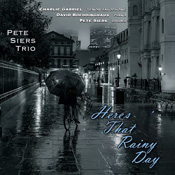
If you have followed Detroit-Ann Arbor jazz for a while, the names Pete Siers and Charlie Gabriel will be familiar. Their relationship goes back to concerts guitarist Hugh Leal produced in Windsor, Ontario, featuring Gabriel on clarinet, saxophone and vocals along with late great Detroit trumpeter Marcus Belgrave. Those live recordings of 2001 and 2002 revealed drummer Siers’ grasp of classic jazz timekeeping. In 2025, Siers and Gabriel teamed up in New Orleans to record a tender and timeless musical document, the 2026 CD Here’s That Rainy Day, for PKO Records with Crescent City pianist David Boeddinghaus. A true believer in maintaining relationships and friendships, Siers recruited Leal to pen the thoughtful notes for this sensitive, sweet and gently swinging sessions.
Leal’s notes introduce us to Boeddinghaus, a New Yorker who migrated to New Orleans, now firmly entrenched in the Big Easy’s vibrant jazz community as the musical director for singer Banu Gibson and her Hot New Orleans Jazz. His resume includes performances with Pete Fountain, Jim Cullum’s Riverwalk Jazz Band and The Louisiana Repertory Ensemble. He is a stride piano virtuoso who also can ably apply modern pianistic technique — his accompaniment for Gabriel’s plaintive balladry on “Angel Eyes” is a case in point.
Plaintive is one of many adjectives to describe Gabriel’s passionate tenor saxophone tone. Jaunty, easy, romantic, warm, delicate, supple, strong, singing, purposeful, brisk, languid and more approaches appear in the twelve tunes covered on Here’s That Rainy Day. Gabriel is a living link to classic saxophonists such as Ben Webster, Coleman Hawkins, Don Byas, Lucky Thompson and Illinois Jacquet. It is obvious that 93-year-old Gabriel was comfortable with the two relative youngsters in New Orleans legendary Esplanade Studio in November 2025.
It is equally clear that Siers is right at home in his second musical community, New Orleans. He balances his work with the Paul Keller Orchestra, the Easy Street Jazz Band, the Kerrytown Stompers, Mr. B (Mark Braun) and more with many outstanding Crescent City ensembles. Siers’ subtle and precise brushwork on “Angel Eyes,” “Body and Soul,” “What Are You Doing the Rest of Your Life” and the title track offer contrast to his Zutty Singleton-inspired drum breaks on “Lady Be Good,” “Just A Closer Walk with Thee” and “You’re Driving Me Crazy.”
Along with Charlie Gabriel and David Boeddinghaus, Pete Siers has created another memorable musical album celebrating and preserving America’s classical music, jazz. Order your CD from pkorecords.com. You will listen with pure pleasure.
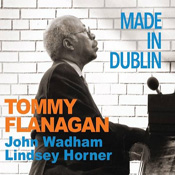
While I detest many of the aspects of today’s high-tech life, I am grateful for the studio and digital technology which restores older and unknown recordings such as the recent CD Made in Dublin by Detroit-born pianist Tommy Flanagan. In August of 1984, Flanagan and his wife Diana vacationed in Ireland. Flanagan had previously appeared at Dublin’s Jazz Fusion Festival in support of saxophonist George Coleman but had never headlined an engagement. He was open to an appearance and casual recording session. The wheels turned quickly and Flanagan was set for a trio concert with legendary Irish drummer John Wadham and young bassist Lindsey Horner.
In the notes Horner shares his memory of the concert, the recording session, and the ease of working with the brilliant Mr. Flanagan. There were no rehearsals before either concert or recording session. As you listen, you will find this hard to believe. The version of the standard warhorse “Summertime” illustrates Flanagan’s vast jazz mindset. He interpolated the riff from Wes Montgomery’s “Four on Six.” Wadham immediately responded with a reggae-influenced backbeat and Horner followed suit.
Flanagan obliged Wadham’s request for a few solo numbers. In honor of Ella Fitzgerald, he chose “Lady Be Good” along with “The Way You Look Tonight” and Thad Jones’ “A Child Is Born.” On Jones’ classic, the pianist’s humanity, creativity, sublime skill and depth of feeling blossomed as he filled in notes between intervals and then let the music breathe to let the song’s emotion resonate. He understood how a good piano will let the note softly decay, enhancing the song’s message.
Flanagan’s bop heritage was also in full force in Dublin: two Charlie Parker tunes, “Relaxin’ At Camarillo,” “Donna Lee,” Thelonious Monk’s “Straight No Chaser” and Oscar Pettiford’s “Blues In The Closet” illustrated his muscularity, fleet fingering and lightning-quick improvisational decisions. The ascending and descending cascades of “Donna Lee” will have you wondering how such dexterity and ideas are humanly possible.
Flanagan was in good health in 1984 and made good new friends in Dublin. You can sense it all the way through the session. We thank the estates of Wadham and Flanagan, engineer Sean Mac Erlaine for his technical wizardry, Horner for the memories, and executive producer Dermot Rogers of Livia Records for sharing the music. For more information, visit liviarecords.com.