

Recent Jazz Recordings by Local Artists
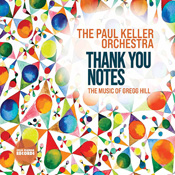
It is sobering if impressive to realize that Paul Keller’s big band is fast approaching its fortieth anniversary. Beginning life on Mondays at the still-lamented Bird of Paradise club in downtown Ann Arbor that was run by one of SEMJA’s principal founders Ron Brooks, the orchestra has moved on through several venues to find a home at the Zal Gaz Grotto Club in a different part of town, with only a short hiatus during the COVID epidemic shutdown. The tradition of jazz big bands getting together on Monday nights, when most clubs were dark, seems to have started in 1965, when the Thad Jones/Mel Lewis Orchestra first got together at New York’s Village Vanguard, now performing as the Vanguard Jazz Orchestra. As part of the commemorations of its successful longevity, the Paul Keller Orchestra (PKO) has released Thank You Notes: The Music of Gregg Hill on Hill’s Cold Plunge Records label, with Paul Keller, bass, leader, and arranger; Mike Williams, Paul Finkbeiner, Joe Palmer, Lucas Stickley-Miner, trumpets; Chris Smith, Terry Kimura, Willie Wang, Chris Glassman, on trombones; the sax section of Keith Kaminski, alto and soprano sax, James Hughes, alto sax, Steve Wood and Chris Tabaczynski, tenor sax, Mark Kieme, baritone sax; with Adam Mosley, piano; Pete Siers, drums; Cary Kocher, vibraphone and bongos; and Sarah D’Angelo, voice and clarinet. The informative liner notes were written by Lazaro Vega.
The Keller big band must rate as one of the finest performing anywhere today, as few can match it for stylistic versatility, artistic enthusiasm, section cohesiveness, technical perfection, and soloist brilliance. When I was writing about its 18th anniversary, Paul Keller estimated that they had about 1,000 charts in their book, so one can only imagine how it has expanded since then. Remarkably, several members of the band have been there almost from the beginning, sometimes off and on, providing fundamental artistic continuity. At the very core are the rhythm duo of the leader on bass and drummer Pete Siers, whose partnership goes back to their college days in Grand Rapids. A jazz percussion explorer, Siers surveys the whole historical and stylistic range of the music, and as a big band drummer he has few equals. Keller is the leader, taking care of all organizational aspects, choosing material, putting his personal stamp on the music as a composer and arranger, but above all by driving the band from the bass. Setting the pace, locking in with the drums, and directing everything from the bass in a manner reminiscent of a somewhat less volatile Charles Mingus, interpreting the music with his personal sense of swing and artistic sensibility, Keller does it all.
On this album Keller has chosen to delve into the seemingly inexhaustible compositional repertoire of Lansing’s Gregg Hill, whose work has been championed by Rodney Whittaker and eventually by other artists from the Michigan State University jazz department, resulting in twenty earlier albums featuring his compositions. On first glance this would appear to be a traditional big band recital of works by one composer in the spirit of the classic Count Basie records featuring the work of Neil Hefti, Quincy Jones, Frank Foster, or Sammy Nestico. But Hill writes bare tunes and likes to leave the manner in which they are organized and arranged to others. This is the first album of his music played by a big band, and in Keller he has found a true collaborator who wrote all the arrangements and is listed as a co-composer on four of the ten “quirky” tunes performed here, to use Keller’s own affectionate description. This association goes back several years, and many of the tunes have been well rehearsed in performances before the band ventured to the Troubadour Studio in Lansing to record them.
This is an album of hard swinging music, opening with “Bopportunity,” an arrangement that starts with a locomotive pattern, leading to the theme and then to solos by two of the longest participating members of PKO — alto saxophonist Keith Kaminski and trumpeter Paul Finkbeiner, whose statements are perfectly aligned with background riffs — followed by ensemble interludes driven by Siers, and finally, after a restatement of the main theme, it all slows down to gently leave us. “Dollah Hollah,” that follows provides an opportunity for comparison with an earlier recording of the composition by Rodney Whittaker on a 2021 album Outrospection, where it was played by a simple quartet. There trumpeter Etienne Charles laid down the initial theme of repeated riffs in a bright straightforward manner, followed by solos, and a reprise of the melody. Keller’s version is radically different: the initial part is stated by Mosley on an electric piano in a slower, almost menacing mysterious manner, with various background instrumental smears and growls, leading to variations that include Finkbeiner in a somewhat wistful mood, playing against several orchestral passages scored with differing voicings, leading to Kaminski, this time on soprano sax; the two then intertwine, leading to a series of orchestral inventions. In this manner Keller turns Hill’s melodic and rhythmic statements into complex orchestral creations. As the recital progresses, he provides ever-shifting perspectives on the music, expanding the compositions with novel variations, shifting tonal textures, and providing ever varying contexts for his first-class soloists. His use of the big band palate is particularly striking. Three compositions feature Sarah D’Angelo’s bright singing, with her perfect sense of pitch sometimes scored as an instrument, reminiscent of Duke Ellington’s incorporation of Ivy Anderson’s voice. Individual instruments such as trumpet, clarinet, vibraphone, baritone sax, or bass trombone sometimes sound independently, only to blend back into the orchestral mix. Tempos and emotional qualities vary. The first half focuses on hard swing, but then with sixth track, “The Speckled Frog,” things calm down for an expanded pensive ensemble statement that leads to a lovely balladic tenor saxophone solo by Steve Woods. “Summer Nights” begins dramatically with low frequency drum rolls, orchestra, but then introduces D’Angelo’s clarinet and Kocher’s vibes, leading to variations that include her vocals and both of their instrumental solos and duos, intertwined with orchestral statements, once again demonstrating how Keller ingeniously exploits the full textural palate of his orchestra for artistic purposes.
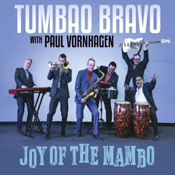
This month brings us another recording by another long-standing local ensemble with national standing, Tumbao Bravo with Paul Vornhagen: Joy of the Mambo, with the leader on tenor and soprano saxophones, flute, piccolo, ocarinas, and Latin percussion; Dave Rajewski, trumpet, flugelhorn, shaker; Armando Vega, congas; Olman Piedra, timbales; Kurt Schreitmueller, piano; and Patrick Prouty, electric bass. The album was recorded during a performance at Ann Arbor’s Blue LLama Jazz Club, evidencing the venue’s stellar sound system and operators.
The personnel of this sextet, originally formed by Vornhagen and conguero Alberto Nacif, has been together for twenty-three years, though has changed over the years, with bassist and composer Prouty the longest member save the leader. Throughout its history, nevertheless, it has always had stellar Latin percussionists, and this edition relies heavily on the authentic rhythmic sensibilities of conguero Armando Vega and timbalero Olman Peidra. Some groups dedicated to this kind of music rely on Latin jazz standards, but one of the characteristics of this band is that most of its repertoire consists of original compositions. Other than two well-known jazz themes, one by Herbie Hancock and another by Tad Dameron, and still another one by bassist Patrick Prouty, all the other tunes were written by Vornhagen.
Tumbao Bravo was formed to play jazz-inflected Cuban music, and this album well exemplifies this tradition which has a long complex history, with one apex on North American shores in New York City during the forties of the last century when Afro-Cuban jazz blossomed in dance bands, especially in the orchestra of Machito who often collaborated with premier jazz soloists. Vornhagen and his bandmates laid this music down in a posh jazz club, but as interesting as the solos are, it is hard to stay still listening to the mambo, rumba, cha-cha, and other rhythms that come alive on the songs. Jazz fans will enjoy the way in which Herbie Hancock’s wistful ballad “Chan’s Song” from the film Round Midnight is given a delicate lilting Latin treatment here. The soloing is pure jazz: on “Hey Pops” the leader on soprano sax, pianist Kurt Schreitmueller, and bassist Patrick Prouty get down in bluesy funk. Throughout, Dave Rajewski’s ensemble and solo playing is a joy, with his warm fluegelhorn providing a particularly good fit with the leader’s way with his horns. There is much variety here as Vornhagen makes full use of his various instruments, including the unorthodox, impressive use of ocarinas as on his own “Rumba Espiritu,” which begins with just him and conga. One of the characteristic traditional Cuban instruments was the flute, especially in the charanga ensembles, often utilizing a simple five-hole wooden instrument in technically virtuosic fashion. Vornhagen’s facility with the modern metal version serves him well as he breaks loose on “Firefly Mambo,” “Gia No Cry,” or “Gratitude.” Cuban flautists often play in the instrument’s highest register, and so the leader pays tribute to this tradition with his piccolo on “Ritmo Bravo.”
An all-around wonderful document of what must have been a fabulous evening at the Blue LLama two years ago.