
Recent Jazz Recordings by Local Artists
The Detroit cultural scene has been continually enriched by the over three-hundred-year perpetual inflow of immigrants from all over globe. Unique local aspects of its powerful jazz tradition have been adopted and cultivated by individual artists drawn to the city from elsewhere and who then spread its musical messages to the world, including Yusef Lateef, originally from Tennessee, Frank Foster and Joe Henderson, from Ohio, Phil Ranelin from Indiana, or Marcus Belgrave from Pennsylvania. This month’s installment of this column features the work of two artists who have made the Motor City area their home, Mike Khoury and Zekkereya El-magharbel, both of Arab American heritage.
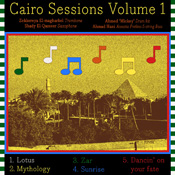
Trombonist, composer, educator, animator and graphic designer Zekkereya El-magharbel has become one of the most innovative interdisciplinary creators on the Detroit area artistic scene. Born and raised in an Egyptian-American family in Los Angeles, he was tutored in music and other arts as a member of the famed Pan African Peoples Arkestra, founded by Horace Tapscott, and as a student at CalArts, developing his unique creative formations and instrumental mastery. Much of his artistic quest is centered around his explorations of his Egyptian musical legacy and family history, and as part of this he spent time last year in Cairo, where he recorded Cairo Sessions Volume 1, Zekkereya El-magharbel, trombone, Shady El-Qasseer, tenor and soprano saxophone, Ahmad Hani, acoustic fretless 5-string bass, Ahmed ‘Mickey’ Riad, drum kit, recorded in Cairo at Cairo Groove, August 2025.
The five compositions on the album were written by El-magharbel. The musicians the visitor chose to work with are well-known in their native land and throughout the Middle East and in Europe. Tenor saxophonist El-Qasseer is a distinguished Cairo performer, organizer, and educator. His pensive original instrumental approach, grounded in traditional modern jazz harmony integrated into native Egyptian melodic, scalar, and rhythmic sensibilities blends well with the leader’s methodology. Both approach improvisation with a deliberate avoidance of fast runs and obvious licks, creating moods and emotional vistas of unconventional beauty. Beneath the horns, bassist Ahmad Hani provides rhythmic and harmonic patterns that alternate between repeated riffs and melodic lines. Hani is a versatile artist who has extensive experience in a broad variety of musical styles from rock, heavy metal, and fusion to Arabic pop and modern jazz. He plays a unique five string acoustic fretless bass made by a Turkish luthier, its long neck provides him with a multi-octave range and a seemingly endless palate of expressive possibilities. El-magharbel’s compositions make full use of his versatile virtuosity. On “Mythology” the drums lay out so that the melody and improvisations are essentially duets with the bass. On “Zar” the introduction belongs to him, beginning with a melancholy melodic statement that turns into a repeated riff that sets up the theme played by the horns. The next tune, “Sunrise,” begins with just trombone and bass, the latter played in chordal manner, bringing the Oud, the Middle Eastern lute (linguistically the place of origin for the word for the instrument in European languages) to mind. Indeed, this track is particularly effective in its seamless blend of Middle Eastern and jazz languages as El-Qasseer switches to the soprano saxophone, utilizing it much like an Egyptian reed flute, relying on local scales (maqamat) while El-magharbel comes in strong with the blues, their scalar cousins. For much of the recital the drums are used sparingly, allowing the bass to carry much of the rhythmic underpinning, but on the last tune, “Dancin’ on your Fate,” drummer Ahmed Riad (“Mickey’) lets loose, as he sets up the tune with a hard driving syncopated funky beat, leading to spirited trombone/saxophone interplay.
Listening to this, one would think that this was a working quartet. In visiting Cairo, El-magharbel obviously discovered a vibrant musical scene filled with experienced creative artists well versed in every kind of music and was able to collaborate with them easily, involving them in the exploration of his compositions. In an interview published in Arab America he noted that “I find that sometimes ‘Arabic’ music can come to refer to music of the Middle East, and that narrative dominates the conversation on Arabic Music as a whole. But if you look at how far-reaching the Arabic language has reached, you find that Arabic music doesn’t necessarily sound one way; it’s not a monolith. There is even a common thread between the Blues traditions in the States, the music traditions in the Western Sahel, and the Arabic Maqam tradition. Many times when I’m playing in a particular melody, it reads as a “blue note” to the others in the audience, a pitch of particular physio-psycho gravity.” All of this comes alive in Cairo Sessions Volume 1; one waits with anticipation for Volume 2!
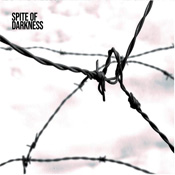
Mike Khoury grew up in Mt. Pleasant in a Palestinian American family but eventually gravitated to the Detroit area, settling in Redford where he operates a performance, rehearsal, and recording studio Entropy Stereo, with its associated internationally famed CD label. His father was an abstract expressionist visual artist who had eclectic musical tastes, ranging from traditional Arabic music to John Cage and the Rolling Stones and much of this left an imprint on Khoury as he took up the violin and made his own way in music. Over the years he has expanded his interests, fascinated by seemingly every kind of music, delving into history and theory, and evolving his own artistic, emotive, and political persona as a passionately committed member of the Palestinian diaspora.
For some years he has been playing with the visionary percussionist, composer, sculptor, social activist, and music archivist Ben Hall, often in duo format (their marvelous out of print cassette Blight in August needs to be made available again, perhaps in a variety of formats!). When violinist Jason Kao Hwang’s Edge ensemble came from New York to the 2025 edition of the annual Edgefest at the Kerrytown Concert House in Ann Arbor, Khoury took advantage of the moment to invite violinist Hwang and his drummer Andrew Drury to record a double duo quartet at the Solid Sound studio in town. The result of this collaboration has now been released as Spite of Darkness, Mike Khoury, Jason Kao Hwang, violins, Ben Hall, trap set, bass percussion, Andrew Drury, drums, with five compositions by Khoury and one co-written with Hall.
The compositions on this album are reflective of Khoury’s broad stylistic interests, from rock, classical, jazz, and avant-garde contemporary music, in which sound and texture are as important as melody and rhythm and the boundaries between written chart and improvisation are often blurred. All the participants are perfectly attuned to such sensibilities, sharing a fascination with exploring the sonic possibilities of their instruments. Drury and Hall are masters of diverse percussive textures, and these are fully exploited on “My First Once More,” where their weave throughout sounds blend and contrast with the strings, Drury’s work almost screeching, while Hall tends to the low bass sounds in methodical rhythmic steady patterns. The first half of the next track is theirs alone focusing on contrasting textural out of time explorations, eventually joined by violin improvisation. Sometimes they provide a wall of wide-ranging sounds as on the opening “To Destroy Every Possible Virtue” or the plaintive “Ghosts of Dead Tribes,” perhaps the most emotionally charged track, where the violins sound almost Brahmsian, play together, go their own ways, overlap, and indulge in call-and-response patterns. At the end, the individual voices contrast as “I Don’t Know How They Got In,” with Hall’s characteristic timpani and low percussion answered by Drury’s trap and cymbal accents, Hwang’s pizzicato and Khoury’s bowing traveling an improvised soundscape, ending with a few drum hits and a fade leaves us in silent awe of four masters at work.